

James Island was once one of Charleston’s agricultural backyards.
Long before suburban neighborhoods and shopping centers spread across the island, its farms supplied Charleston with vegetables and other provisions, helping feed the growing city just across the Ashley River. Agriculture wasn’t simply part of the landscape; it was part of Charleston’s food system.

That history is becoming harder to see.
Like so many of the Sea Islands surrounding Charleston, James Island has experienced extraordinary development pressure. Fields have become subdivisions, farm roads have become thoroughfares, and the rural landscape that once connected Charleston to its food has steadily been fragmented.
So it seemed fitting that I found myself thinking about preservation at Cannon Distillery on James Island. I wasn’t looking at an old Charleston house or a historic storefront. I was looking at a glass of rum—and inside it was an heirloom crop every bit as worthy of historic preservation.
The occasion was the release of a gunpowder-strength, single-barrel Wadmalaw Island Rhum Agricole made from fresh-pressed St. Croix Purple Ribbon sugarcane grown at Sugar Daddy Farms.
To appreciate what was in that glass, you have to understand the remarkable journey that brought this cane back—from nineteenth-century Southern fields, through decades of decline, into the hands of scientists and farmers determined to revive it, and finally into a still on James Island.

It is a story about agriculture. But it is also a story about preservation.
The Rise, Loss, and Revival of Purple Ribbon Cane
In his landmark book Southern Provisions, food historian Dr. David Shields documents how sugarcane took hold in coastal soil. While early planters experimented with tropical strains, it was the 1825 introduction of purple-striped ribbon cane to the Sea Islands that transformed regional agriculture. Hardier and far more cold-tolerant than earlier varieties, Purple Ribbon allowed coastal growers to withstand sudden autumn frosts. Along the coastal South, enslaved Africans brought extensive agricultural knowledge from West Africa and the Caribbean, and that mastery proved vital to the cultivation, milling, and boiling of sugarcane across Lowcountry plantations.

For generations, sugarcane was woven directly into the rhythm of the Lowcountry year. Stalks were planted, cut, crushed, and boiled as the weather turned toward fall. Families and communities gathered around cane presses and massive kettles, turning fresh juice into a dark, intensely flavored syrup that sustained households throughout the winter. This wasn’t a nostalgic specialty boiled for tourists—it was essential food, hard agriculture, and a body of practical knowledge passed down through generations. You can still feel that living history in the crisp autumn air during a Lowcountry cane grind, where the heavy, sweet steam rises off cast-iron kettles as fresh juice slowly transforms into liquid gold.
Eventually, the modern agricultural economy pushed in another direction. Sugarcane mosaic virus devastated Southern fields during the twentieth century, forcing commercial growers toward high-yield, disease-resistant hybrids. Older heirloom canes were abandoned, and Purple Ribbon virtually disappeared. By the time researchers began searching for it again, the variety survived only in scattered historical collections.
Bringing Purple Ribbon Back
Bringing Purple Ribbon back to life required an unlikely coalition of experts working across very different disciplines.
Dr. David Shields laid the groundwork by scouring nineteenth-century herbarium specimens and archival documentation to verify what true Purple Ribbon had been and where its lineage might still exist. At Clemson University, plant geneticist Dr. Stephen Kresovich brought modern science to bear, using DNA sequencing and micro-propagation techniques to isolate pure, disease-free tissue cultures. Finally, plant geneticist Dr. Brian Ward brought the crop out of the laboratory and into the dirt at Clemson’s Coastal Research and Education Center, mastering the delicate organic field propagation required to turn tiny laboratory clones into harvestable seed cane.
Preserving a seed in a freezer is not the same thing as growing a crop. A living agricultural tradition requires someone to plant it, harvest it, save the cane, plant it again, and find a reason to keep doing so.
That is what makes Purple Ribbon part of a broader South Carolina resurrection that includes Carolina Gold Rice, Sea Island Red Peas, Jimmy Red Corn, the Bradford Watermelon, benne, and the Carolina African Runner Peanut. Each crop has required historians, scientists, farmers, chefs, and distillers to bridge the gap between what once existed and what can exist again. The objective isn’t simply to save old seeds—it is to put them back into the working landscape and regain the lost flavors of our shared history.
From Sapelo Island to Wadmalaw Island
Purple Ribbon eventually returned to coastal soils, starting on Sapelo Island in Georgia before finding a home much closer to Charleston at Sugar Daddy Farms on Wadmalaw Island.
That geographic connection is deeply meaningful. Wadmalaw, Johns Island, James Island, and the surrounding Sea Islands aren’t simply scenic coastal real estate; they are the historic agricultural engine that fed Charleston for centuries. When you look across those fields today, it can be easy to view them as empty spaces waiting for development. Historically, they were vibrant working landscapes where crops were tended, cane was pressed, and knowledge was inherited. Once that landscape disappears, bringing the crops back becomes infinitely harder.
The Purple Ribbon revival isn’t just a botanical curiosity—it is an act of cultural preservation.
From Cane to Rhum
At Cannon Distillery on James Island, the Purple Ribbon story takes a unique culinary turn. For generations, Lowcountry cane went from field to press to boiling kettle. This cane went from field to press to fermentation tank to still.
The primary difference lies in how the juice is handled. Traditional syrup relies on boiling down fresh cane juice over heat, whereas rhum agricole ferments and distills the raw juice directly. Fresh cane juice is wildly perishable; once crushed, natural fermentation begins almost immediately, leaving the distiller a razor-thin window to process the liquid. Industrial molasses can sit in a tank for months; fresh cane juice cannot wait.
The Funky White Dog and Terroir in the Glass
The initial unaged spirit—the “white dog”—was earthy, vegetal, raw, and intensely expressive of the plant itself. That raw, grassy intensity immediately brought to mind the unaged rhum agricole produced by High Wire Distilling—a striking reminder of how dramatically fresh cane juice carries historic flavor profiles that industrial molasses completely erases.
In Southern Provisions, Dr. Shields makes a poignant observation about modern agriculture: sugarcane was never systematically bred by commercial markets for flavor, but rather for sheer sucrose yield. In doing so, modern industrial food systems lost what Shields calls the cane’s natural “dulcetness”—the subtle finesse and flavor complexity that heirloom varieties possess. It is a refrain heard from the post-war advent of industrial monoculture all the way to today: when you focus solely on shelf life, portability, and economy of scale, flavor loses out. Every. Single. Time.
To capture that historic “dulcetness” and tame the initial white-dog funkiness without stripping away the cane’s natural identity, Cannon aged their Wadmalaw Island rhum in a single barrel for six years.
Bottled at gunpowder strength, the aged rhum reveals surprising complexity: rich, savory notes of bacon intermingling with aromatic Tahitian vanilla, leading into a long, generous maple finish backed by a lingering, coastal earthiness. As loathe as I am to say it, to simply mix it into a tiki drink would waste its true potential. It confirms what craft distillers have long suspected: terroir isn’t stripped away by distillation—it’s concentrated.
Tasting History
The evening was completed by Chef James London’s offerings. His hyper-local seafood from Chubby Fish brought the marine half of the Lowcountry landscape into the room—connecting the tidal creeks and estuaries to the surrounding fields. (And yes, it brought the Chubby Fish Line with it as well.)


Charleston’s historical foodways were never neatly divided between land and water. Rice grew in coastal fields, shrimp came from the creeks, oysters were harvested from estuaries, and sugarcane grew along the sea islands. Serving this single-estate rhum alongside pristine local seafood told a unified story of field and tide, past and present.
Purple Ribbon sugarcane is back in Lowcountry soil, being harvested, distilled, poured into glasses, and paired with contemporary Charleston cuisine. That isn’t a museum piece—that is history with a pulse.
Experience Charleston’s Food History
This intersection of land, sea, and history is why I do what I do. The true history of Charleston lives in the ingredients our farmers grow, the heritage techniques cooks preserve, and the stories we share around the table.
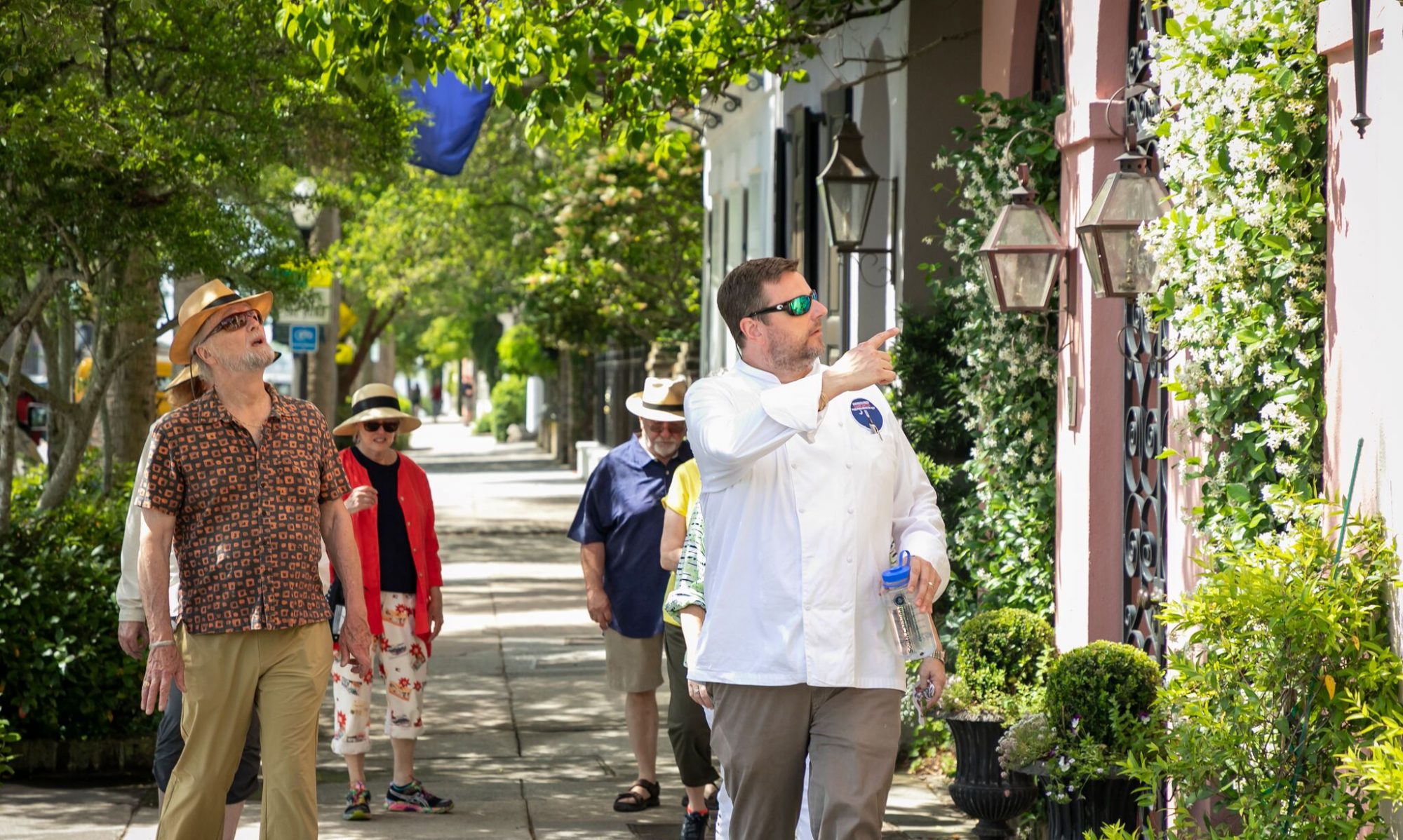
If you want to understand Charleston through the flavors that built it, come walk the city with me. On an Undiscovered Charleston tour, we explore these deep culinary roots through the streets, markets, and kitchens of the Holy City. We begin with a historic walking tour focused on Charleston’s history through the lens of its food: heritage crops, European, Native American and West African foodways, followed by a live three-course cooking demonstration and wine-paired lunch at Le Bistro by Azur.
[Reserve Your Spot on an Undiscovered Charleston Tour →]
(Space is strictly limited to keep groups small, personal, and immersive.)
Purple Ribbon Sugarcane: Frequently Asked Questions
What is Purple Ribbon sugarcane?
Purple Ribbon sugarcane is an heirloom variety of Saccharum officinarum, a species of sugarcane historically cultivated in the American South and Caribbean. The variety became particularly associated with coastal South Carolina and Sea Island agriculture.
What is the history of Purple Ribbon sugarcane?
Purple Ribbon sugarcane became an important Southern crop following its 1825 introduction to the Sea Islands before mosaic virus and changing agricultural practices led to its near extinction in the early 20th century. As detailed in Dr. David Shields’ book Southern Provisions, modern researchers—including Dr. Shields, Dr. Stephen Kresovich, and Dr. Brian Ward—worked to identify, propagate, and return heirloom cane varieties to cultivation.
Where is Purple Ribbon sugarcane grown today?
Purple Ribbon cane is currently cultivated in South Carolina’s Lowcountry, notably at Sugar Daddy Farms on Wadmalaw Island, as well as historical heritage sites like Sapelo Island in Georgia.
What is the connection between Purple Ribbon sugarcane and Charleston?
Purple Ribbon connects Charleston to the agricultural history of the Sea Islands, Caribbean trade, Gullah Geechee foodways, Southern cane-syrup traditions, and modern heritage spirits like Cannon Distillery’s Wadmalaw Island Rhum Agricole.
Why is Purple Ribbon sugarcane important to the Lowcountry?
Its revival helps preserve the agricultural history, farming knowledge, and distinct coastal flavors associated with the Sea Islands, ensuring that regional heritage crops remain active in contemporary cuisine rather than surviving only as museum artifacts.
What is rhum agricole?
Rhum agricole is a style of rum traditionally made by fermenting and distilling fresh sugarcane juice rather than industrial molasses. Using fresh cane juice allows the distinct terroir, mineral, and vegetal qualities of the sugarcane to carry over directly into the spirit.
What does “gunpowder strength” mean for rum? “Gunpowder strength”—historically known as navy strength—refers to spirits bottled at 100 proof (50% ABV) or higher, traditionally around 57.1% ABV. The term originates from 18th-century British Royal Navy tradition, where rum aboard warships had to be strong enough that if a barrel leaked onto the ship’s gunpowder, the wet powder would still ignite. In Cannon Distillery’s Wadmalaw Island Rhum, this higher proof prevents water dilution from masking the complex, natural flavor compounds of the heirloom Purple Ribbon sugarcane.
For Further Reading & References
- Shields, David S. Southern Provisions: Creating a Regional Cuisine. University of Chicago Press, 2015. (See Chapter 13, “Sugar from the Sugarcane,” pp. 253–270, for the history of Sea Island cane planting and the 1825 arrival of purple ribbon cane).
- Hitt, Jack. “Cane Syrup: The Forgotten Harvest.” Garden & Gun, Apr/May 2014. (A narrative account of traditional Lowcountry cane harvests, syrup boiling, and the work of Jimmy Hagood).
- Neimark, Jill. “The Lost Ancestral Peanut Of The South Is Revived.” NPR, Dec. 2016. (Documenting Dr. David Shields and Dr. Brian Ward’s research bringing the Carolina African Runner Peanut back from extinction).
- Post and Courier. “The South’s original peanut revived in South Carolina.” The Post and Courier, Mar. 2014. (Local coverage detailing Clemson’s Coastal REC field trials and the agricultural repatriation of the Carolina runner peanut).
- Neimark, Jill. “From Hooch to Haute Cuisine: A Nearly Extinct Bootlegger’s Corn Gets a Second Shot.” NPR, Aug. 2018. (Exploring the agricultural repatriation of Jimmy Red corn).
- Clemson University Coastal REC. Heirloom Crop Research & Seed Multiplication Program. Clemson University Department of Plant and Environmental Sciences. (Documentation on the tissue culturing and field propagation work of Dr. Brian Ward and Dr. Stephen Kresovich).