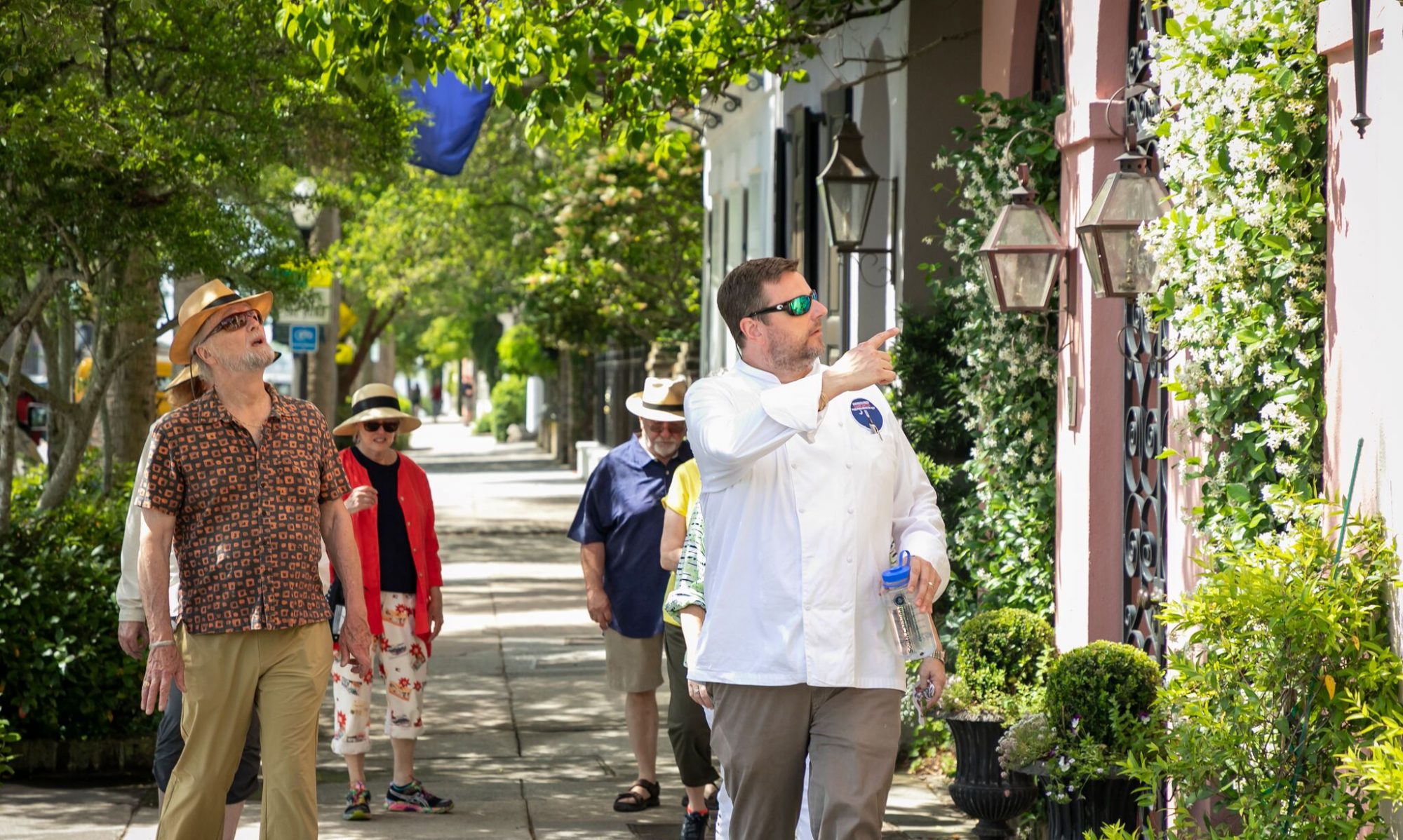


By Chef Forrest Parker
If you walk past 54 Market Street in Charleston today, you’ll see a lively rooftop patio and the relaxed confidence of an iconic address dating back to 1932. But long before the building became part of Charleston’s modern restaurant scene, it was home to one of the city’s most influential culinary institutions.
As eminent culinary historian Dr. David S. Shields notes:
“Henry’s was the much more famous palace of cuisine and was much more central to the evolution of restaurant dining in Charleston.”
Henry’s on Market Street was a historic Charleston restaurant located at 54 Market Street whose surviving menus provide a rare record of how Charleston dined in the years before and after World War II. They reveal everything from restaurant prices and seasonal dining habits to Lowcountry seafood, French culinary influence, and the evolution of signature regional dishes such as deviled crab and She-Crab Soup.
Henry’s on Market Street: From Grocery to Restaurant
Long before classical French sauces met Lowcountry seafood, German immigrant Henry Otto Hasselmeyer ran a bustling Market Street grocery on this very site.
During Prohibition, the building operated as a discreet “Blind Tiger” liquor hub. Family lore even recalls Mrs. Hasselmeyer concealing a small beer keg beneath her skirts during an 1897 police raid!
When Prohibition ended, Henry Jr. shortened the family name simply because the sign painter charged by the letter.
The restaurant’s early offerings were humble: cold beer, deviled crabs, and fresh oysters served to a rugged waterfront crowd. But Henry’s would eventually become something considerably more ambitious—a restaurant whose menus document the growing sophistication of Charleston dining.
What the 1939 Henry’s Menu Reveals About Charleston Dining
By July 1939, the nation was emerging from the Great Depression and approaching the upheaval of World War II. Henry’s surviving 1939 menu and its rare tipped-in daily sheet offer an extraordinary glimpse into the practical realities and culinary ambitions of a Charleston restaurant at the time.
Depression-Era Value: The “Shore Dinner”
In 1939, money was tight and dining out was a luxury. Henry’s promoted multi-course “Famous Shore Dinners” starting at just 75 cents, giving price-conscious locals an accessible way to enjoy a substantial seafood meal.
The menu is a reminder that restaurant dining was not simply about luxury. Successful restaurants also had to understand their customers, their budgets, and the value they expected for their money.
Celebrating Local Bounty: The 15-Cent Deviled Crab
Deviled crab was priced at a modest 15 cents.
By pairing inexpensive native blue crab and local seasonings with a more formal restaurant presentation, Henry’s demonstrated something fundamental about Lowcountry cuisine: humble local ingredients could be transformed into sophisticated restaurant fare.
That same culinary tradition survives today. You can explore the history and preparation of this classic dish in our Original Recipe for Henry’s Historic Deviled Crab.
The 1939 Henry’s Menu
The surviving July 1939 menu is more than a list of dishes. It is a primary document of Charleston food history, recording prices, seafood preparations, seasonal offerings, and the restaurant’s approach to dining on the eve of World War II.
The accompanying tipped-in special sheet is particularly revealing because it shows how Henry’s adjusted its offerings during the summer.


Original Henry’s restaurant menu from 1939, including the dated summer special sheet. The menu provides a rare snapshot of Charleston restaurant dining, prices, and Lowcountry seafood preparations on the eve of World War II.
Managing the Summer Menu
The dated special sheet explicitly states:
“Table d’Hôte Dinners Discontinued for the Summer.”
Instead, Henry’s offered à la carte “Cold Plates” ranging from 50 to 75 cents.
The change illustrates the practical challenges of operating a restaurant in Charleston’s hot summer climate. Rather than maintaining a fixed multi-course menu, Henry’s could adjust its offerings and manage inventory through a more flexible à la carte approach.
It is a small detail, but this is exactly the kind of information that makes an old restaurant menu so valuable to culinary historians. A menu tells us not only what people ate, but how restaurants actually operated.
The Luxury Impulse: Maine Lobster Comes to Charleston
The menu also carries a fascinating piece of national food marketing: a promotional sticker from the State of Maine Lobster Association.
Its presence on a Charleston menu demonstrates how local restaurants were increasingly connected to a broader American food marketplace. Maine lobster could be presented alongside Charleston’s native seafood as an exotic, premium ingredient—a reminder that even a distinctly Lowcountry restaurant was participating in national culinary trends.
French Technique Meets Lowcountry Seafood: The Post-War Era
Henry’s post-war menus reveal the profound influence of classical European technique on Charleston’s native seafood, driven by the remarkable journey of Chef John Bolton.
Chef John Bolton got his start at Henry’s as a young man, working in a junior role, and was then promoted into a kitchen assistant role. When World War II broke out, he was drafted and served in Europe. Following his service, Chef Bolton remained in Paris to undergo formal French culinary training under the G.I. Bill—studying classical Auguste Escoffier brigade methods in Paris aroughly the same time Julia Child was attending Le Cordon Bleu.
When Bolton returned to Charleston, he made the conscious choice to bring his newly acquired mastery back to the Jim Crow South. Leaving behind the relatively egalitarian social climate of post-war Paris, he chose to apply elite French technique to native Lowcountry ingredients at 54 Market Street.

Prior to Bolton’s return, signature dishes like Flounder à la Gherardi (a delicate fillet wrapped around a sherry-spiked crab stuffing) and Seafood à la Wando simply did not exist on Henry’s menu. His arrival demonstrated how classical European discipline could elevate local catches into world-class dining.
This is an important distinction in the history of Charleston cuisine. The evolution of Lowcountry cooking was not a rejection of local ingredients in favor of European food. Instead, native seafood became the canvas upon which chefs like Bolton applied sophisticated culinary techniques.
Chef John Bolton’s Influence on She-Crab Soup
One of the most intriguing clues to Chef John Bolton’s influence appears in the preparation of She-Crab Soup.
Rather than adding raw sherry at the table as a finishing gesture, Bolton began incorporating the sherry directly into the soup base during the cooking process. The result was a more consistent, deeply integrated flavor from bowl to bowl—a technique that shifted emphasis to kitchen discipline rather than dining-room theater.
Henry’s After the War: The Bolton Era
The second surviving menu offers a fascinating contrast with the 1939 document.
Although it does not carry a dated special sheet, archival telephone exchange records show Henry’s retaining the direct 4-digit number “5933” through the immediate post-war years (c. 1945–1951), prior to Charleston’s city-wide transition to named exchanges like RAymond-2. By this point, Henry’s menu reflects an increasingly sophisticated restaurant culture where Charleston’s native seafood was being interpreted through a formal French culinary vocabulary.


An undated postwar Henry’s menu, dating to approximately 1948–1951 based on its direct 4-digit telephone number “5933” and menu details. The menu illustrates the restaurant’s evolution and the French-influenced kitchen discipline of Chef John Bolton.
Together, the two menus tell a larger story.
The 1939 menu captures Henry’s as a Charleston restaurant rooted firmly in local seafood, value-conscious Depression-era dining, and Lowcountry tradition. The post-war menu reveals a restaurant transformed by formal European training, national supply chains, and the broader culinary shifts shaping mid-century American dining.
The Legacy of Henry’s on Market Street
Henry’s is important not simply because it was an old Charleston restaurant. It matters because its surviving menus allow us to see culinary change happening in real time.
They document the prices Charleston diners paid, the seafood they valued, the dishes restaurants considered worthy of their dining rooms, and the techniques chefs used to transform familiar local ingredients.
They provide a bridge between two versions of Charleston cuisine: the traditional Lowcountry table and the sophisticated restaurant culture that helped lay the groundwork for Charleston becoming one of the nation’s premier dining destinations.
📖 Dig Deeper into the History
Discover the full story behind the silver spoon, Chef John Bolton’s Paris training, and the complete mid-century evolution of 54 Market Street in Chef Forrest’s original investigative feature:
The Secret of the Silver Spoon: Refining Henry’s on Market
HTML
Taste the Real History Behind Lowcountry Cuisine
Charleston’s history isn’t just stored in archives—it’s written in its recipes. Join South Carolina Chef Ambassador Forrest Parker for an unscripted 3-Course Culinary & Heritage Experience featuring traditional Lowcountry dishes, live cooking demonstrations, and paired fine wines.
Select Date & Book Direct With Chef Forrest✔ Best Rate Guarantee | ✔ Instant Confirmation
HTML