

The unassuming entrance to 10 Exchange Street held one of the most prestigious dining rooms in America.
Charleston is a city of high water and deep memories, a place where the humidity clings to the skin like a damp silk shroud and the air tastes eternally of pluff mud and forgotten nobility. To walk these streets is to traverse a living autobiography, written not in ink, but in the softened red clay of Charleston’s oldest buildings. If you possess the heart to listen, the Holy City speaks its truth through its bones—and few places hold more gravity than 10 Exchange St.
Today, 10 Exchange Street stands in Charleston’s French Quarter as one of the city’s oldest surviving commercial buildings and the former home of Perdita’s Restaurant, a nationally recognized mid-century dining landmark. just off East Bay Street, 10 Exchange St is one of the oldest continuously adapted commercial buildings in Charleston, South Carolina, a structure that has absorbed nearly three centuries of labor, appetite, and ambition without ever surrendering its footing.
A Bastion of Brine and Burden (1740–1800)
Long before the whispered elegance of white linen graced its interior, 10 Exchange St was a muscular, salt-crusted beast of a building. Erected circa 1740, its thick walls were built to shoulder the crushing weight of an empire. Standing at the water’s edge, it inhaled the tide and exhaled the commerce of the world.
In this era, Lowcountry food was never abstract—it was freight. It was the Carolina Gold rice and indigo that made the planter class impossibly rich, a wealth extracted through the stolen agricultural genius of enslaved Africans. The street was a cacophony of clattering carts and the desperate shouts of street hawkers & sailors. Here, food was power, labor, and the primary currency of the transatlantic trade.
Taverns, Vice, and the Architecture of Survival
As the decades deepened, the building entered a turbulent adolescence. It became a historic Charleston tavern, a house of ill repute, and a sanctuary for men unmoored by the sea. Wherever the tall ships docked, a specific kind of hunger followed—a hunger for salted pork, cheap rum, and the fleeting warmth of a stranger. These weren’t scandals; they were the inevitabilities of a port city.

By the mid-19th century, the address bore witness to an aching, fragile hope. During Reconstruction, the surrounding district bore witness to the city’s fragile reinvention, as relief efforts and newly freed Black Charlestonians reshaped the economic life of downtown.The cries of street hucksters—calling out fish, greens, hot bread, and whatever could be spared that day—echoed between the brick walls, carrying both sustenance and defiance through the street. For newly freed Black Charlestonians, a meal was a manifesto; nourishment was the first, vital step toward a freedom the city had long denied.
The Perdita’s Era: When Fine Dining Found Its Heart

When the menu was a handwritten love letter to the Lowcountry tides.
In 1953, the building underwent its most famous metamorphosis. Gordon W. Bennett opened Perdita’s, and the Charleston dining scene quietly stepped into the modern light. This was the birthplace of the refined Lowcountry aesthetic.


Stepping through the door at 10 Exchange Street was a journey into a storied past. Located in a pre-Revolutionary dwelling in the heart of Old Charlestowne, Perdita’s was far more than a local favorite; it was a culinary landmark recognized on the world stage. While Holiday Magazine frequently signaled it out as a premier destination for ‘Dining Distinction,’ its most staggering achievement was being named one of only five restaurants in the U.S. to receive the Medal of Honor from the Council of Paris. Bearing the seal of the city of Paris and the defiant motto Fluctuat nec mergitur, the award cemented Perdita’s reputation as a bastion of French-influenced excellence, tucked away behind two-foot-thick brick walls that had survived hurricanes, earthquakes, and the passing of nearly two centuries
Taste the History Where It Lives
Charleston is often accused of being a museum frozen in amber, but 10 Exchange St proves it is a living, breathing organism. It has survived by shedding its skin:
- The 1740s: A maritime warehouse and trade hub
- The 1800s: A public house, tavern, and brothel
- The 1860s: A corridor of Reconstruction and relief
- The 1950s: The vanguard of Charleston fine dining
To truly understand the South, you cannot simply read a menu. You must walk the path where the ghosts of the past still linger in the aroma of brown butter and tidal brine.
Experience the Story with Undiscovered Charleston

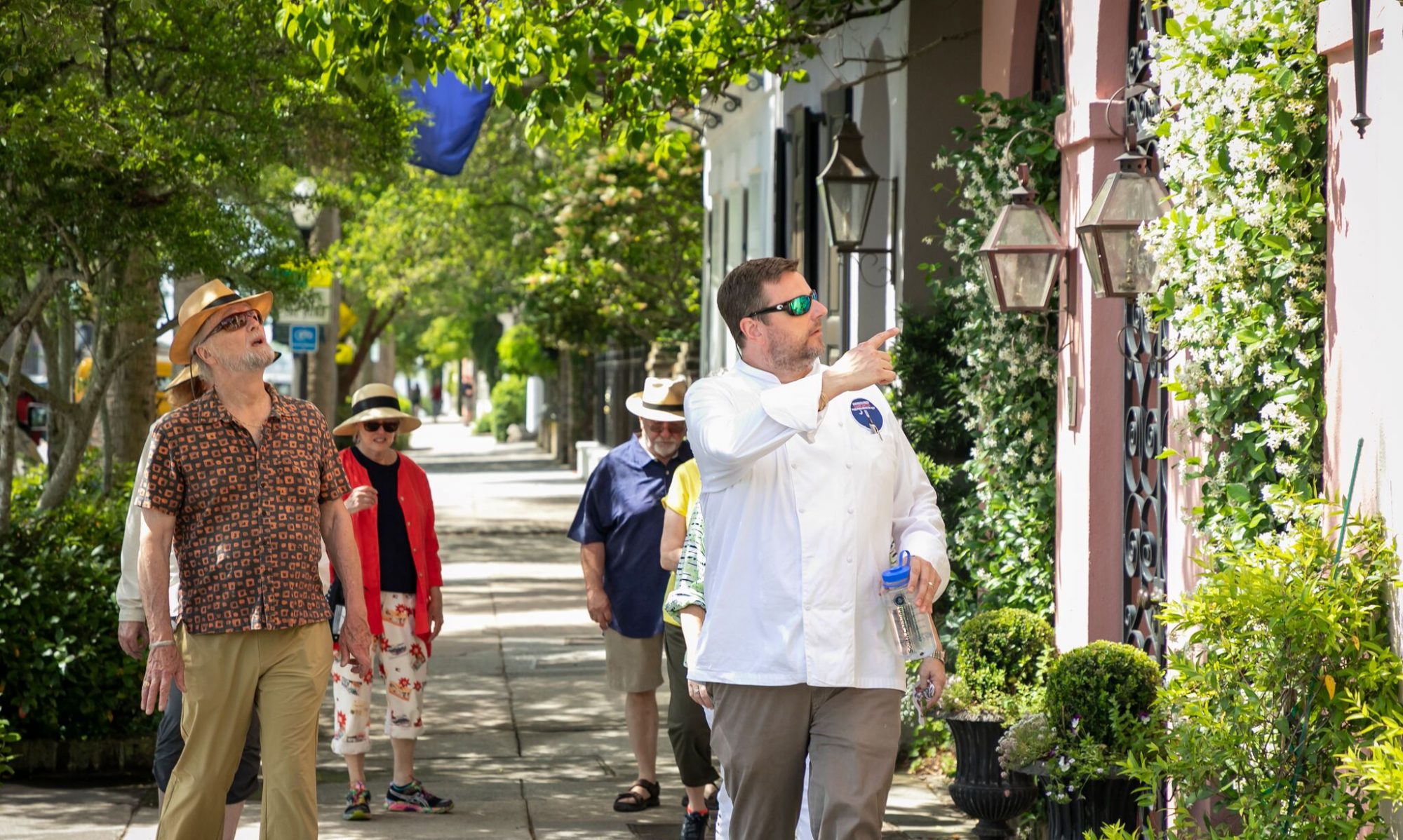
Don’t just visit the Holy City—shuck its shell and taste the deep brine of Lowcountry history, and know immediately: that’s the taste of Charleston. Led by SC Chef Ambassador and historian Forrest Parker, Undiscovered Charleston connects the stones of 10 Exchange St to the flavors on your plate today.
Book your Undiscovered Charleston tour direct and walk the path from warehouse to white tablecloth. Taste the history where it has always lived: in the kitchens, the stories, and the heart of the Lowcountry.

4 Replies to “The Ghosts of Charleston’s Restaurants Past: Perdita’s”